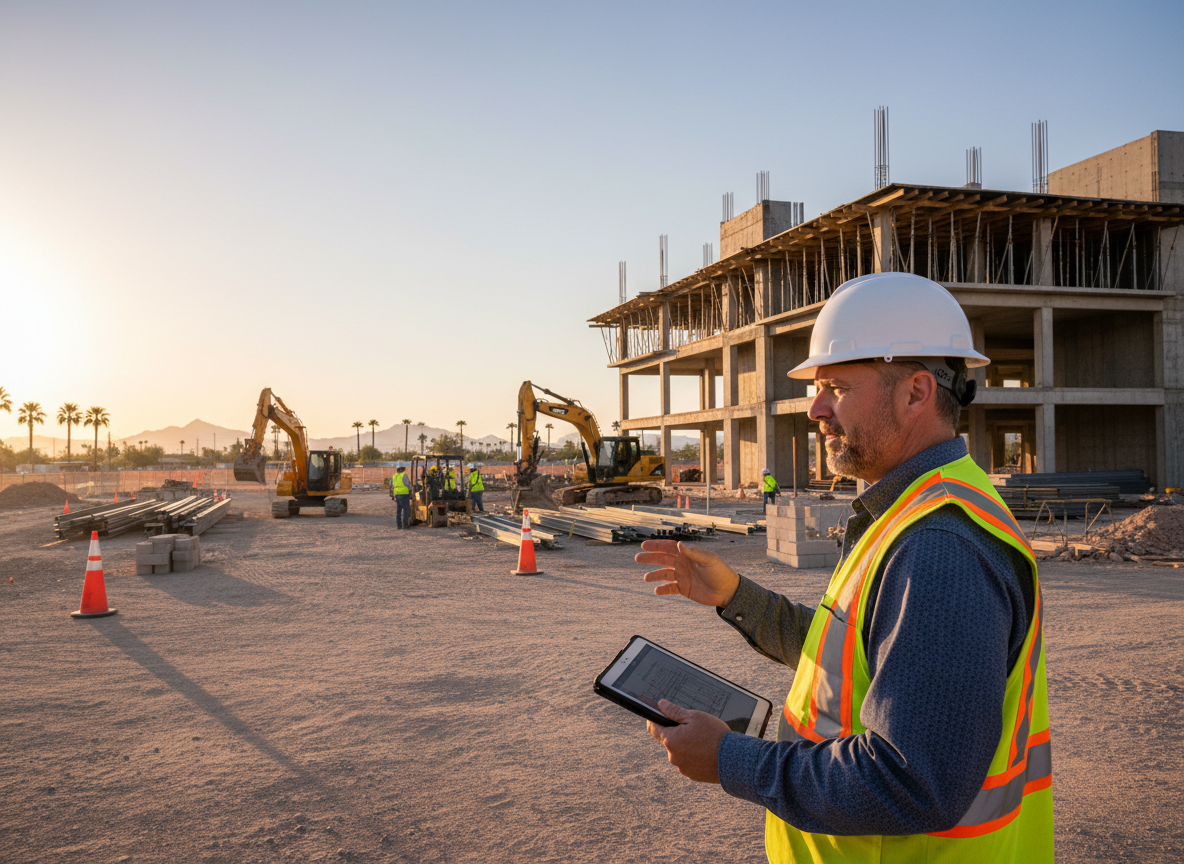
Commercial work in Gilbert requires careful attention to the hot desert climate where summer temperatures routinely exceed 110 degrees and can delay concrete pours or cause rapid curing issues on projects in Agritopia or San Tan Ranch. Crews must schedule pours during cooler early morning hours and use additives to control hydration rates when working near the Riparian Preserve or Heritage Court. Maricopa County permitting adds another layer because inspectors expect documentation on thermal expansion joints and reflective roofing to handle intense UV exposure.
Building stock in Layne Heights and Power Ranch often mixes older masonry commercial structures with newer steel-frame additions, so tie-in details must address differential movement from soil expansion after monsoon rains. Queen Creek and Chandler border projects frequently involve coordination with irrigation districts and storm-water management plans that affect foundation depths. Local crews know to verify existing utilities against county records before excavation to avoid the shallow laterals common in these older commercial corridors.
Tenant improvement work in Downtown Gilbert demands fast turnaround while maintaining code compliance on fire separations and ADA access routes. Material selection must account for daily temperature swings that stress sealants and expansion joints more than in milder nearby cities like Mesa. Experienced contractors sequence deliveries to avoid heat-related equipment failures and maintain quality control on finishes that will face constant sun load.
Technician insight
In Gilbert, the thing that catches most people out with Commercial General Contractor is underestimating how 110-degree days stretch concrete cure times and force schedule changes on sites near the Riparian Preserve where afternoon shade is limited.
Retail Tenant Improvement in Downtown Gilbert
A new retailer needed interior build-out of an existing masonry building. We found the roof deck had insufficient slope for local drainage and several penetrations lacked proper flashings for desert UV. We added tapered insulation, replaced flashings with heat-rated materials, and adjusted the schedule to early mornings. The space passed final inspection on time and opened without leaks after the first monsoon season.
How it works
- 1
Initial Site Assessment
Walk the property in Gilbert to document existing conditions, soil exposure, and access constraints typical of Maricopa County commercial sites.
- 2
Scope and Budget Development
Prepare detailed plans that incorporate desert climate detailing such as reflective materials and expansion provisions for local temperature extremes.
- 3
Permitting and Coordination
Submit to Maricopa County and coordinate with utilities serving areas like Agritopia and Power Ranch before mobilization.
- 4
Construction Execution
Manage phased work with heat-mitigation schedules and daily inspections to maintain quality through summer conditions.
- 5
Final Walkthrough and Handover
Review all systems with the owner and provide documentation for ongoing maintenance in the local climate.
Pricing
Project pricing is developed from detailed scope after site visit and provided as an upfront written estimate.